
When Men
Shut Down
Using Somatics to Deepen EFT With Men

When Men Shut Down – Workshop for Therapists
The full 75-minute recording, the slide deck, a clinical reference PDF, and written answers to every question asked in the live chat — all in one place.
If you know a therapist who works with men or couples, send them here.
A couple enters conflict. One partner escalates emotionally. The other shuts down.
You track the cycle. You slow the process. You reach for the withdrawn partner — invite him toward the deeper feeling. And he says: "I don't know." Or: "I'm fine." Or he moves into explanation, analysis, logic.
From your chair, this can look like avoidance. Resistance. Emotional absence.
Very often, something else is happening.
His nervous system has already moved outside the window of tolerance. And once that happens, the man has disconnected — from his somatic experience, from his emotions, from his partner. Talking at him in that state doesn't open the door. The door is already closed.
The emotional door EFT relies on
is often closed before the intervention begins.
Emotionally Focused Therapy has given therapists one of the clearest maps available for attachment repair. It works. The research is deep. The method is sound.
But many therapists who work with men encounter the same wall. EFT's emotional access requires a nervous system that is available. In many men — especially under relational pressure — the nervous system has already shifted into a survival state before emotional awareness can emerge. The attachment question lands in a body that cannot receive it.
This is not a failure of the model. It is a missing layer — one that Polyvagal Theory has named precisely.
When the nervous system settles, emotional signals appear. When emotional signals appear, attachment repair becomes possible. This was the core of what George and Owen covered: how to apply Polyvagal Theory practically inside a session.
A map of attachment repair
Track emotional cycles, identify attachment needs, guide partners toward new experiences.
The physiological entry point
Settle the nervous system first — so the emotional signals EFT works with can actually emerge.
Emotional precision
One of the most rigorous, research-backed models for relational repair available to clinicians.
Somatic access for men
MELD does not replace EFT. It opens the door EFT needs open in order to work.
Practical tools.
Immediately usable.
This 75-minute workshop introduced practical ways to integrate somatic awareness into EFT work with men. Here is a full recap of the seven things covered — then scroll back up to watch the full recording.
Why many men can't access emotion in session — even when they want to
Dysregulation of the nervous system blocks emotional awareness even when the client is motivated. Understanding the physiology changes how shutdown looks from the therapist's chair — and changes what you reach for next.
The somatic question that opens what emotional questions can't
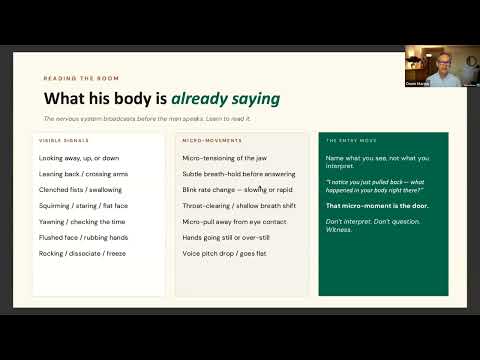
When therapists ask "What are you feeling emotionally?" — many men freeze. When therapists ask "What do you notice in your body right now?" — many men can answer immediately. That shift is not a detour. It is often the only available doorway.
The MELD ROC Method — Body → Emotion → Connection
A simple, trainable three-part sequence that moves men from defensive physiology into emotional contact:
This progression mirrors the goal of EFT — and gives therapists a physical path into it.
The male stress cycle therapists often misread as resistance
What looks like stonewalling or avoidance is usually physiological overload. Recognizing this cycle changes the intervention:
What looks like emotional avoidance is often a nervous system in survival mode.
The Somatic Entry Question — and what to do in the 30 seconds after
A simple intervention therapists often report using the next day. Combined with a brief physiological reset, this question consistently allows emotional signals to emerge that emotional questions alone fail to reach. The full question, the reset, and the sequence that follows are in the recording and on the reference sheet.
Watch the full progression unfold in real time
A male client moving from cognitive explanation into emotional expression and relational contact. Body → Emotion → Connection — not as a concept but as something you can watch happen. The clips below show pieces of this in practice.
Why men's groups accelerate what individual therapy builds toward
When men see their emotional defenses mirrored in other men, something shifts that individual work alone often cannot produce. Well-structured groups do three specific things:
- →Create a psychologically safe space that normalizes defensive patterns
- →Encourage risk-taking within each man's window of tolerance
- →Create social contagion of regulation — men co-regulating in real time
In these environments, men often discover how to give and receive secure attachment with other men before bringing that capacity back into their primary relationships.
Three moments from the workshop.
Watch before you watch the rest.
Three moments from the session — watch below, then scroll back up for the full 75-minute recording.
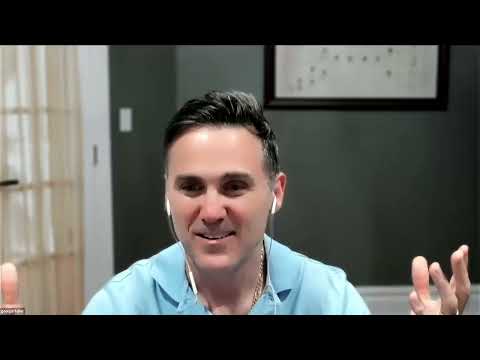
Why Men Shut Down Is Not Resistance
George explains what's actually happening in a man's nervous system the moment he goes quiet in session — and why it isn't avoidance.
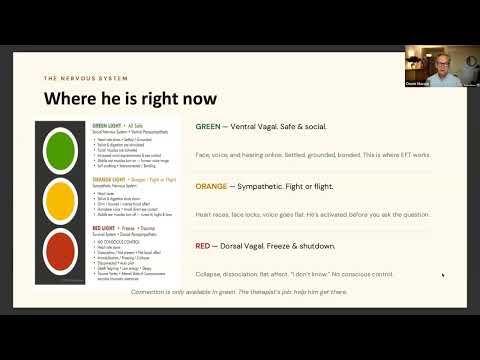
What Looks Like Resistance Is Actually a Freeze Response
The physiology behind shutdown — and why pushing harder on a frozen nervous system backfires.
When Men Shut Down, Start With Safety — Not Pressure
What to reach for instead of pressure when a man in session goes quiet.
Ready for the full 75-minute session?
Watch the Replay →
Three audiences.
One shared problem.
You practice couples therapy. You work with men. You hit the same wall.
This workshop was built for therapists who practice couples therapy or Emotionally Focused Therapy, work with men or couples, regularly see emotional shutdown in session, and want practical somatic tools they can use immediately — not just theory.
The replay gives you a clinical framework, a somatic sequence, and a question you can try the next day. Therapists who want to go further often continue into MELD Core or our Integrated Training program — more on that below.
You've tried everything. You need a different explanation.
You have asked more clearly. More gently. You've stopped asking and waited. Sometimes nothing reaches him. What you're experiencing is real. And it is not about whether he loves you.
When relational pressure rises, many men's nervous systems move into a survival state before they can think, feel, or respond. The shutdown is not indifference. It is physiology — wiring that was often laid down long before you met him.
If you're working with a therapist, share this with them. It may be a language for conversations you haven't been able to have yet.
You know the moment. Something happens and you're already gone.
It doesn't feel like shutting her out. It feels like surviving.
Here's what most men were never told: that feeling is physiological. Your body moved into a survival state before your mind had a chance to respond. You are not broken. You were never taught how to stay in your body when the stakes feel high.
That is a trainable skill. Men learn it every day. If you have a therapist or couples counselor, share this with them. If you're thinking about getting one, this is a good place to start.
This workshop was an introduction.
These are the next step.
"When Men Shut Down" is a 75-minute taste of the MELD Method. For therapists who want to build real fluency — in their own bodies first, then in their clinical work — MELD offers two paths.
The foundational MELD Method experience — embodied, relational, and group-based. Many therapists go through MELD Core first, as participants, before bringing the work into their practice. It's the same Embodied → Relational → Communal arc that underlies everything George and Owen taught in the workshop.
Built specifically for clinicians who want to integrate somatic, MELD-based tools into their existing clinical model — including EFT. Faculty-led, with case consultation and a community of practitioners doing this work with men.
Two decades of work.
Both in the room.
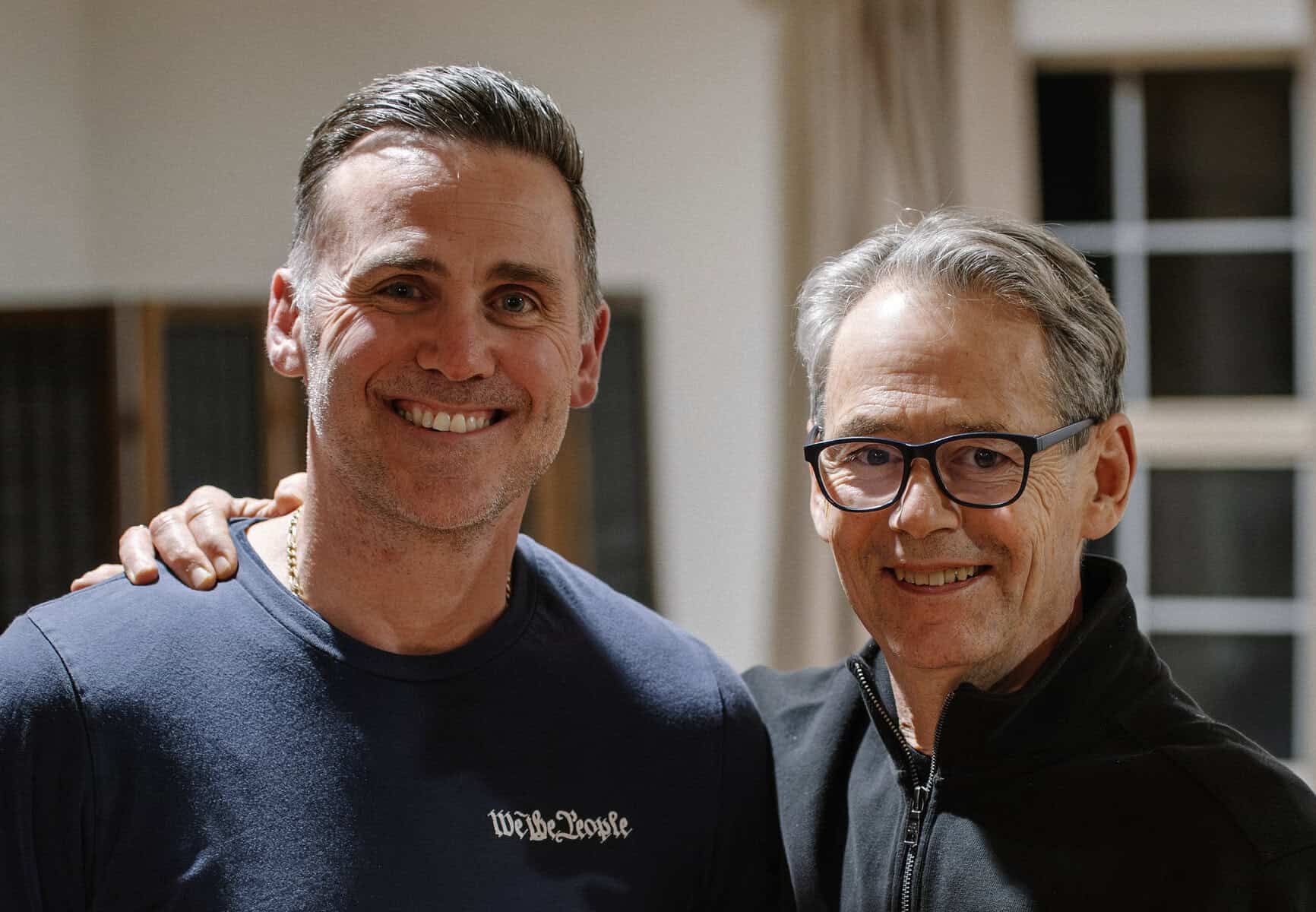
George Faller
EFT Trainer · Author · Former NYPD & NYFD
George Faller has spent decades working at the intersection of attachment science and men's emotional lives. As a man who led others through high-stakes environments in the NYPD and NYFD before becoming one of EFT's foremost trainers, George understands what shuts men down — and what reaches them.
He has trained therapists across the country in how to use a man's existing coping patterns as entry points, not obstacles. He is nationally recognized as an expert in Emotionally Focused Therapy.
Owen Marcus
Co-Founder, MELD · Creator of the MELD Method
For thirty years, Owen Marcus has worked with men — in groups, in therapy settings, in business and community contexts — on the question of how men actually change. The MELD Method grew from that work: a somatic-relational approach that starts with the body because that is where men are most often available to begin.
Owen has trained men, therapists, and organizations across the world in how to use physiology, emotion, and community as tools for connection. His work is grounded in Polyvagal Theory, Somatic Experiencing, EFT, Hakomi, and IFS.
Dr. Sue Johnson.
Owen Marcus.
EFT's creator and MELD's co-founder in the same room. This workshop brought together the two frameworks that are reshaping how therapists reach men — the emotional map and the physiological entry point that makes the map usable.
"The body holds what words cannot yet reach. When men learn to feel safe in their bodies, the emotional door opens — for them and for the people they love."
Sue Johnson, Ph.D. · Creator of Emotionally Focused Therapy
Sue Johnson, PhD and Owen Marcus
reaching men in session.

Watch the Session
From the people
doing this work.
The work Owen did with me, and in watching him masterfully work with other men. Owen is able to guide men to uncover and discover new parts of themselves and their human experience and begin to heal in ways that are only rarely possible in this life for most men.
Brad Koch, MFT
Tapping into the core human feelings as they arise in the body, and sharing those experientially with other men in small groups, proved to be meaningful work, which I have taken with me into my own practice and work with others. It's a counterintuitive modality for those of us who are intellectually or psychodynamically inclined, and I believe a growing part of healing-helping work.
Justin R. Cambria, LCSW, MBA
Over ten years, I've sent men to Owen and watched them come back different – more present, more open, more capable of real connection. That's a big thing. The MELD Method works for men. It supports any form of therapy.
Dalia Anderman, LMFT
The framework.
In 75 minutes.
Everything in the recording, laid out before you watch:
- The MELD somatic framework and how it integrates with EFT
- The Somatic Entry Question — and the sequence that follows
- The ROC Method: a three-part clinical tool for male clients
- A clear model of the male stress cycle and how to interrupt it in session
- The live demonstration: Body → Emotion → Connection in real time
- Questions from the live session, answered during the workshop
One page. Keep it at your desk. The Male Stress Cycle, the Somatic Entry Question, the ROC Micro-Reset, three body signals of emotional activation, and when to shift from emotional to somatic language in session.
Download the Guide →
Questions about
men's groups.
What is a men's group?
Are men's groups the same as therapy?
Do men's groups actually work?
Why do many men's groups fail or fall apart?
What happens in a typical men's group meeting?
Who are men's groups for?
Do men have to share personal details in a men's group?
Next Step
How to Join a Men's Group — and Choose One Worth Your Time
Before asking about emotion,
ask about the body.
If you work with men or couples, try this in your next session.
Notice what happens. Notice whether that shift — away from the emotional question, toward the physical sensation — opens something that was closed a moment before.
Very often, the body already knows the answer. This is exactly what the workshop builds on. Watch the full session to see it in practice.
Watch the Replay →